
The Zero-Waste Move: A Richmond to Pakenham Relocation Without a Skip Bin
Why This Richmond Family Decided to Move Without a Single New Box
Most people moving house start the same way: a trip to the hardware store or Bunnings for a stack of boxes, a roll of tape, a bag of packing peanuts and a giant sleeve of bubble wrap. It’s the default, and it’s what almost every moving checklist tells you to do. But for one household relocating from Richmond to Pakenham, that wasn’t good enough. They wanted a move that left nothing behind for landfill — not the boxes, not the wrap, not the tape.
It’s a bigger issue than it looks. According to Sustainability Victoria, Australians throw out roughly 1.9 million tonnes of packaging every year — enough to fill the MCG nine times over. Moving day packaging is a small slice of that number, but it’s one almost every household creates at least a few times in their life, and most of it is entirely avoidable. EPA Victoria also points out that a lot of recyclable packaging still ends up in landfill rather than being recovered, simply because it’s easier to throw it in the general waste bin once the move is done.
This family decided to prove there was another way, and their approach is a genuinely useful blueprint for anyone planning a move across Melbourne, whether that’s a short hop across the suburb or a longer trip like theirs from the inner east all the way out to Pakenham.
Packing With What Was Already in the House
Instead of ordering boxes, the family did an inventory of what they already owned that could double as a container. Suitcases, laundry baskets, dresser drawers pulled straight out of the furniture, buckets and even large cooking pots all became packing vessels. Nothing needed to be bought, and nothing needed to be thrown away once they arrived in Pakenham, because everything was simply put back to its original use.
This is a small mindset shift, but it makes a real difference. A chest of drawers doesn’t need to be emptied into boxes before it goes on the truck — the drawers themselves are the boxes. A empty plant pot in the garden can carry garden tools or smaller items instead of sitting empty on the truck. Even the humble laundry basket, normally reserved for washing, became one of the most useful packing tools in the house.
Protecting Fragile Items Without Bubble Wrap
Glassware, plates, artwork and electronics are usually where people reach for bubble wrap and polystyrene packing peanuts first. This household swapped both out for towels, tea towels, blankets and bedsheets they already had in the linen cupboard. Wrapped around plates, glasses and picture frames, soft linen does the same cushioning job as bubble wrap, and it travels to the new house doing exactly what it was always meant to do — being used as linen again, rather than being unwrapped and binned on the other end.
The same approach worked for the television and computer monitors. Rather than searching for the original foam-lined boxes, the family layered blankets and towels around the screens and secured them with paper tape, which is biodegradable and breaks down far more easily than the plastic tape most people default to. Where they did need extra structure for genuinely fragile pieces, they used biodegradable packing peanuts rather than the polystyrene kind, which are notoriously difficult to recycle and rarely accepted in kerbside collection.
Solving the Wardrobe Problem
Clothing is one of the trickiest parts of any move to do without plastic. This family avoided garbage bags and plastic wrap entirely by using two methods. Some clothes went straight into the plastic crates they’d sourced specifically because they could be returned after the move, rather than kept or thrown away. Everything still on hangers was moved on a portable clothing rack — a port-a-robe — which meant clothes arrived in Pakenham ready to hang straight back in the wardrobe, with no wrinkling and no waste generated at all.
Reusable shopping bags and storage tubs filled in the gaps for shoes, accessories and linens that didn’t need a full crate.
Clearing Out Before Moving Day, Not After
One of the simplest but most effective decisions this household made was timing. Rather than packing everything they owned and sorting it out later, they held a garage sale and donated a full carload of items in the two weeks before their move date. Anything they hadn’t used in the past year and didn’t have a genuine reason to keep either went to a neighbour, a local charity shop, or a buyer through a local marketplace group. It meant fewer items to pack in the first place, which is the most reliable form of waste reduction there is — not creating the waste to begin with.
Loading the Truck for the Trip to Pakenham
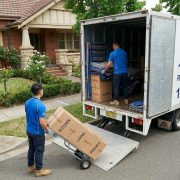
On moving day, the crates, port-a-robe, drawers-as-boxes and linen-wrapped fragile items all went onto the truck exactly as they were. There was no last-minute dash for extra boxes, no half-used roll of tape thrown out because the job was already done, and no bin bag of packaging waste waiting at the kerb in Richmond the next morning. The trip out to Pakenham took a little over an hour, and the load arrived exactly as intended — protected, secure, and completely reusable at the other end. Fully insured cover meant the family had the same peace of mind as a traditional move, without any of the packaging waste that usually comes with it.
Unpacking in Pakenham With Nothing Left to Throw Out
The real payoff came at the unpack. There was no pile of flattened boxes to break down and take to the recycling centre, no bag of bubble wrap and polystyrene to figure out what to do with, and no plastic bags to throw away. The suitcases went back under the bed, the laundry baskets went back to the laundry, the drawers slid back into the dresser, and the plastic crates and port-a-robe were simply returned. Within a day, there was no evidence a move had even happened — just a family settled into their new home in Pakenham.
Why More Melbourne Movers Are Doing the Same
This kind of move isn’t a niche idea anymore. As more Melbourne households look for ways to cut down on landfill and avoid the cost of buying moving supplies twice, zero-waste packing is becoming a genuine option for anyone moving house — not just the highly organised or the environmentally minded. It costs less, it takes roughly the same amount of planning as an ordinary move, and it leaves nothing behind to deal with once the truck has gone.
If you’re planning your own move and want a team that’s used to working around reusable crates, port-a-robes and a packing plan built from what you already own, Jake Removals has handled plenty of moves exactly like this one, from Richmond and right across Melbourne’s inner and outer suburbs.
References
- Sustainability Victoria, How to reduce packaging
- EPA Victoria, Used packaging materials