

What 600+ Moves Tell Us About Richmond: An Inside Look at How Richmond Really Moves
Richmond: Small Homes, Big Turnover
Richmond sits roughly 3 km east of the Melbourne CBD in the City of Yarra, wedged between the Yarra River, Punt Road and Hoddle Street. It is one of Melbourne’s oldest suburbs, and it still shows: rows of Victorian terraces and single-fronted workers’ cottages sit beside converted warehouses and newer apartment blocks along Swan Street, Bridge Road and Victoria Street.
The 2021 Census (Australian Bureau of Statistics) counted 28,587 people in Richmond, with a median age of 34, four years younger than Victoria overall. The housing mix is almost the reverse of the state average:
- 53.0% of dwellings are flats or apartments (Victoria: 12.1%)
- 30.7% are terraces, townhouses or semi-detached homes (Victoria: 13.9%)
- Only 15.6% are separate houses (Victoria: 73.4%)
Richmond homes are also smaller. The average dwelling has 2.2 bedrooms compared with 3.1 statewide, and two-bedroom homes alone make up 43.8% of the suburb. Most importantly for anyone in the removals business, 54.7% of Richmond households rent, almost double the Victorian figure of 28.5%.
That combination of compact homes, young residents and a renter-majority population is the backdrop to everything in our numbers below.
Richmond Moving Statistics: What Our Jobs Show
The figures below come from the Richmond Moving Statistics on our removalists Richmond page, drawn from jobs where Jake Removals moved customers into or out of Richmond.
Moves by property size
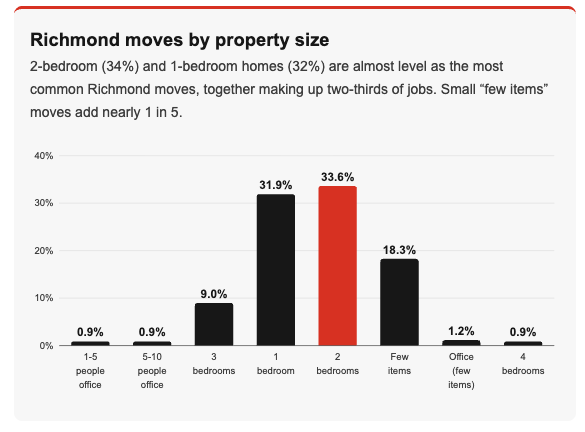
Most Richmond moves are small homes. Two-bedroom homes are the most common job at 33.6%, with one-bedroom homes close behind at 31.9%. Together they make up about two-thirds of the Richmond moves we handle. “Few items” jobs add another 18.3%, which covers single pieces of furniture, a studio, or a shared-house room. Three-bedroom homes account for just 9%, and four-bedroom homes and offices are rare. This matches the suburb itself. The 2021 Census shows Richmond’s homes average 2.2 bedrooms, compared with 3.1 across Victoria. More than half of households rent, and nearly 4 in 10 people live alone.
Moves by distance
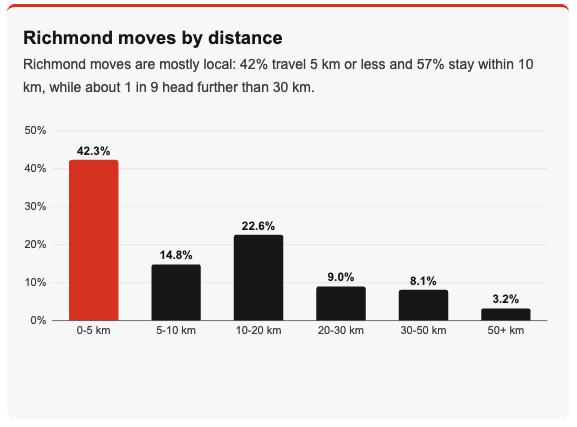
Richmond moves tend to stay local. Of all Richmond moves, 42.3% travel 5 km or less and 57% stay within 10 km. Another 22.6% go 10–20 km, and only about 1 in 9 head more than 30 km. Many Richmond residents live around trams, trains and walking, and nearly 1 in 5 households don’t own a car. So when they move, they usually stay close to the city, often to Cremorne, Abbotsford, Collingwood, South Yarra or another Richmond street.
Moves by job length
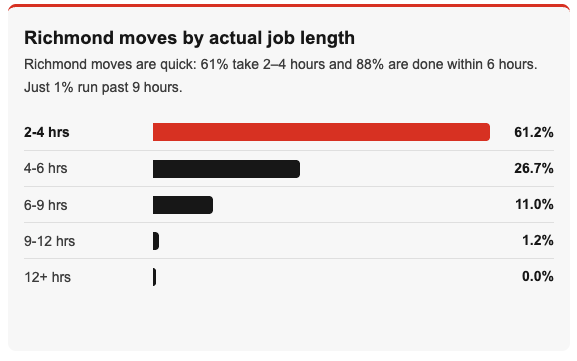
Most Richmond moves are quick. 61.2% take 2–4 hours, and 88% are done within 6 hours. Just 1.2% run past 9 hours, and none take longer than 12. Small homes and short trips explain this. A one- or two-bedroom apartment moving a few kilometres is usually a half-day job for a two-person crew. The longer jobs are mostly the less common three-bedroom homes, walk-ups, and moves heading out to the outer suburbs.
Property types
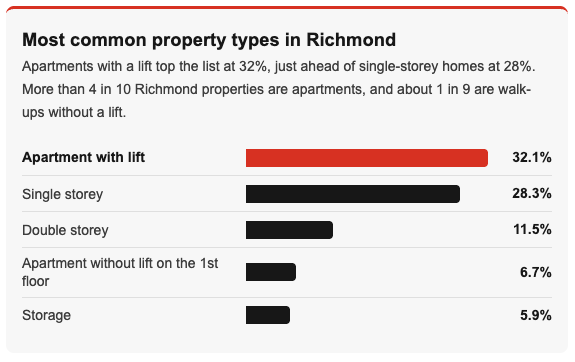
Apartments with a lift are the most common property we move in Richmond, at 32.1%. Single-storey homes come next at 28.3%, followed by double-storey homes at 11.5%. Walk-up apartments without a lift make up 6.7%, and storage units 5.9%. This follows Richmond’s housing mix. The 2021 Census found 53% of homes in the suburb are flats or apartments, and many of the single-storey homes are Victorian cottages and terraces. In these properties, booking the lift, carrying items up and down stairs, and finding street parking often affect how long the move takes more than the amount of furniture.
Why Richmond Has These Figures
Renters move more often, and they rent small
With more than half of Richmond households renting, the suburb has a constant flow of lease endings, new leases and shared-house reshuffles. Renters generally move more often than owners, and in Richmond they tend to live in the suburb’s large stock of one- and two-bedroom apartments and terraces.
That is why one-bedroom homes punch above their weight in our data. They make up 22.4% of Richmond dwellings in the Census, but 31.9% of our Richmond jobs. Smaller rentals simply turn over faster.
Family homes stay put
The opposite is true at the larger end. Three- and four-bedroom homes make up about 32% of Richmond dwellings, yet only around 10% of our moves. These are more likely to be owner-occupied terraces and houses where families settle for years. When they do move, it’s a big job, but it happens far less often.
Lots of people living alone
The ABS found 38.7% of Richmond households are lone-person households, compared with 25.9% across Victoria. Average household size is just 2 people. Single occupants usually own less furniture, which explains the strong 18.3% share of “few items” jobs: a bed, a couch, a desk and some boxes rather than a full house.
People want to stay close to the city
Over 42% of our Richmond moves stay within 5 km. Richmond residents are heavily tied to inner-city living. Census data shows only 24.3% drive to work (Victoria: 49.9%), while walking, trams, trains and bikes all run well above state averages. Nearly one in five households (19.3%) have no car at all.
When your life is built around a tram line or a short walk to the CBD, the next home is usually nearby: Cremorne, Abbotsford, Collingwood, South Yarra, Hawthorn or another Richmond street. Those short hops are what fill the 0–5 km bracket.
Small homes and short trips mean short jobs
Put a one- or two-bedroom home together with a local trip, and you get a 2–4 hour job. That’s why more than six in ten Richmond moves finish in that window. The longer jobs in our data tend to be the less common three-bedroom homes, walk-up apartments, or moves heading 30 km or more out to the suburbs.
Apartments and heritage terraces shape moving day
With 53% of Richmond dwellings being flats or apartments, it’s no surprise that apartments with lifts top our property list. These moves depend on booked service lifts, loading bays and building rules more than on raw volume.
Richmond’s single-storey properties are often Victorian cottages and terraces: narrow frontages, tight hallways and limited street parking. They’re quick to load in volume terms, but access is what decides how smoothly the day goes. Walk-ups add stair carries that can stretch a short job.
Storage fills the gaps
The 5.9% of jobs involving storage reflects how often Richmond lease dates don’t line up. A renter finishing one lease before the next starts, or someone heading overseas for a year, often needs somewhere to park their belongings in between.
What This Means If You’re Moving in Richmond
If you’re planning a Richmond move, the numbers point to a few practical takeaways:
- Most jobs are short, so an hourly rate and a two-person crew usually suit one- and two-bedroom homes.
- Book the lift early if you’re in an apartment. Building access is often the biggest factor in how long the job takes.
- Mention stairs and parking upfront, especially for terraces and walk-ups.
- Ask about storage if your lease dates overlap or leave a gap.
Jake Removals moves homes, apartments and offices in and out of Richmond every week. Every move is fully insured, and our prices and trucks page explains how rates work. For a quote built around your building and your move date, get in touch with Jake Removals.